A clearing house of maps, static & dynamic tools, and related publications.
Supported by the Sierra Nevada Acoustic Monitoring Program, an array of over 1,700 autonomous recording units that span the entire Sierra Nevada forest ecosystem. The project generates 1,000,000 hours of audio annually, which is analyzed with the BirdNET algorithm, yielding data about >100 species of birds, mammals, and amphibians.
Jump to: Tools – Select Publications – Contributors – Support
Conservation Tools
Bird Population Projections: Fire, Restoration, and Climate
We combined climate models, forest fire projections, fuel reduction scenarios, and population models for eight bird species in a set of 50-year projections of bird population viability and forest restoration. The resulting maps enable managers to identify areas of co-benefits, tradeoffs, and co-losses to fuel reduction and biodiversity, while population projections enable managers to balance long-term goals and short-term risks to forests and birds.

Interactive Biodiversity + Management Simulation Maps
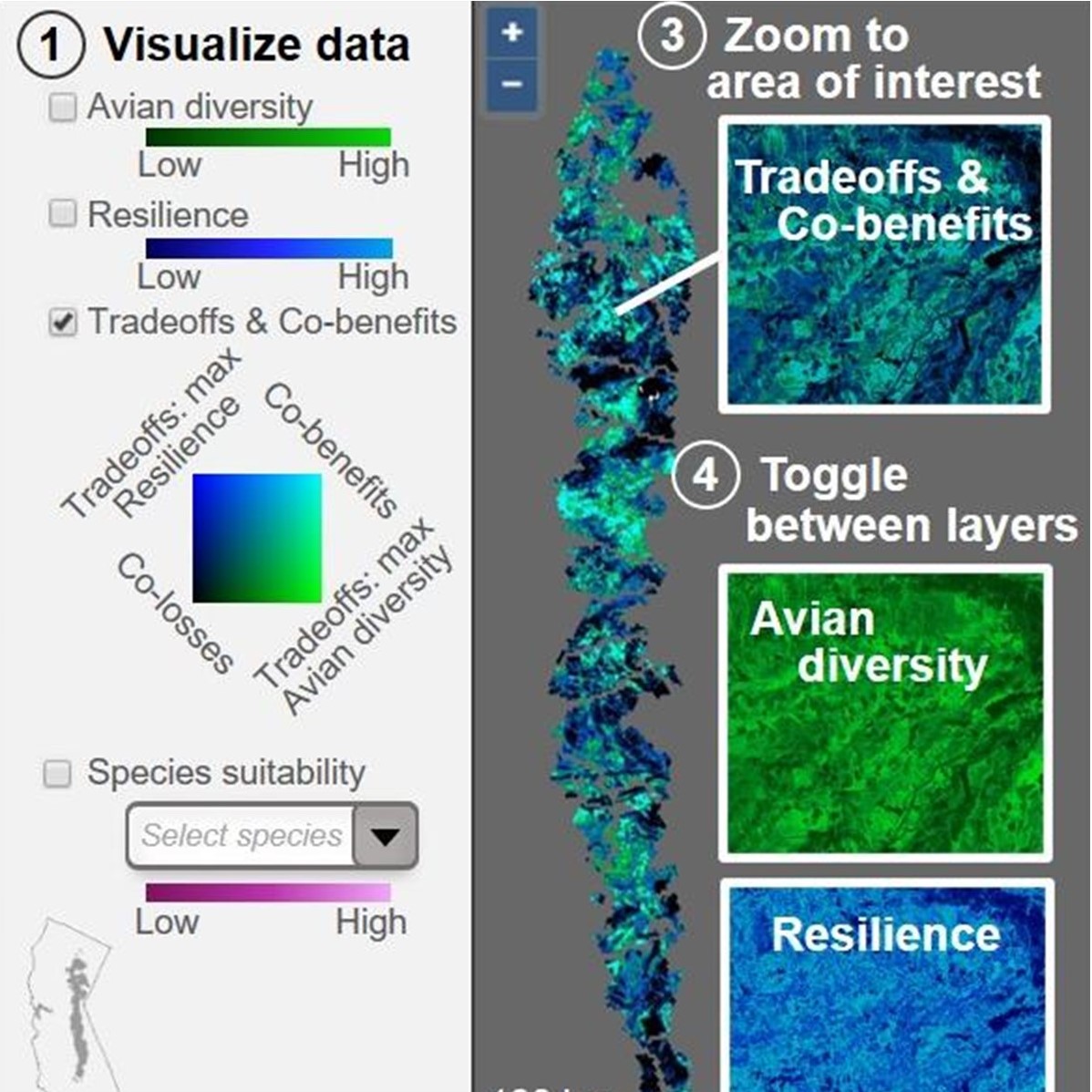
This interactive tool allows managers to simulate the effects of forest management activities on bird populations and forest resilience within user-defined project areas. The tool is powered by bird population models that were built using passive acoustic survey data from 2021 and a state-of-the-art forest structure map. The forest structure data is updated annually, and the estimated baseline bird occupancy rates change accordingly.
Select Publications
- Quail on fire: Changing fire regimes may benefit mountain quail in fire-adapted forests (2023). The first comprehensive, ecosystem-scale survey of any Sierra Nevada bird species reveals a potential winner in changing fire regimes.
- Arresting the spread of invasive species in continental systems (2022). Describes the successful removal of invasive Barred Owls from the entire Sierra Nevada.
- Forest restoration limits megafires and supports species conservation under climate change (2021). A synthesis of wildland fire models and a California Spotted Owl population model that served as a model for the ‘Bird Population Projections’ project.
- BirdNET: a deep learning solution for avian diversity monitoring (2021). A technical description of the machine learning tool used to generate avian population data in this project.
- Detecting small changes in populations at landscape scales: A bioacoustic site-occupancy framework (2019). Simulation-based power analyses that laid the groundwork for the monitoring program’s long-term design.
Contributors
Dr. Connor Wood. K. Lisa Yang Center for Conservation Bioacoustics, Cornell Lab of Ornithology, Cornell University
Dr. M. Zach Peery. Dept. of Forest and Wildlife Ecology, University of Wisconsin – Madison
Dr. Gavin Jones. Rocky Mountain Research Station, USDA Forest Service
Dr. LeRoy Westerling, UC-Merced
Dr. Van Kane. University of Washington
Dr. Alina Cansler, University of Montana
Dr. H. Anu Kramer, University of Wisconsin – Madison
Support






 Connor M. Wood