Population ecology of rare or imperiled species
Conservation research on rare or imperiled species is a core strength, and span the life cycle of detector development, survey design, simulation-based power analyses, disturbance ecology, natural history, and more. Current focal species include:
- Spotted Owl (US: Threatened/Endangered)
- Pinyon Jay (Tipping Point Yellow-Alert; IUCN Vulnerable)
- Yosemite Toad (US: Threatened; IUCN Vulnerable)
- Marbled Murrelet (US: Threatened; IUCN Vulnerable)
- Gray Wolf (California) (US: Endangered; California ‘Species of Greatest Conservation Need’)
- Tapir Valley Treefrog (IUCN Critically Endangered)
- Antioquia Wren (IUCN Vulnerable)
- Orange-bellied Parrot (IUCN Critically Endangered)
- Cape Parrot (IUCN Vulnerable)
Community ecology
The rise of passive wildlife sensors, machine learning animal detectors, and ever more detailed satellite data opens up new possibilities for the creation of ecosystem-scale biodiversity datasets – and thus new ways to ask and answer important ecological questions. Various axes of “biodiversity” tend to the be focus, rather than individual species, and we aim to make insights into higher-order processes like ecosystem functioning and stability.
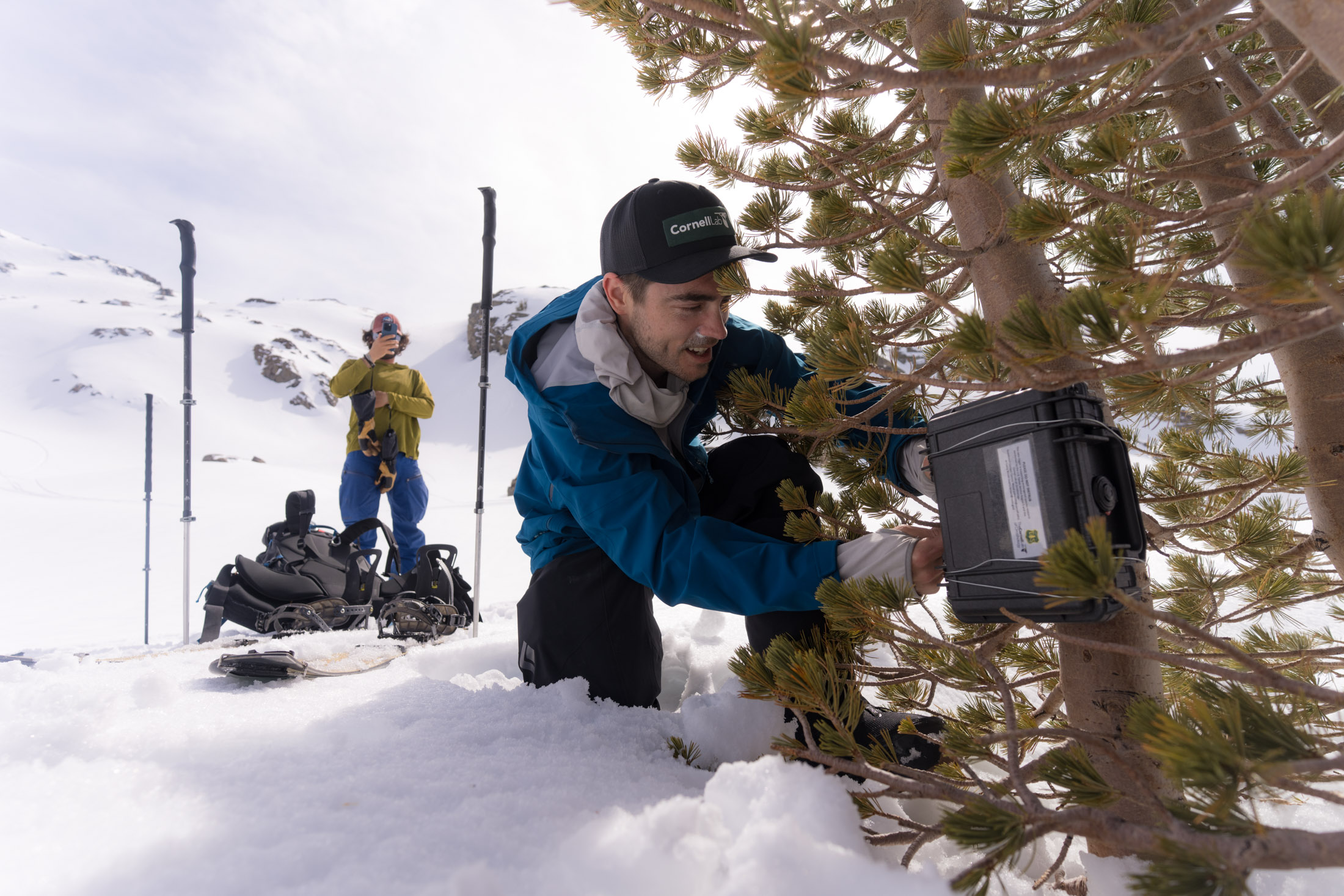
- Biodiversity monitoring in California. Our flagship project began in 2016 and now spans California’s Sierra Nevada (>1,600 recording units across 25,000km2). Beginning in 2023, an additional ~200 recorders were deployed across 6,000km2 in Southern California) and globally. From the beginning it has been a close collaboration with Dr. Zach Peery.
- Ecological integrity in La Selva Maya. La Selva Maya is the largest Neotropical forest north of the Amazon, and ~15% of it lies within the Mayan Biosphere Reserve in northeaster Guatemala. The Yang Center is working in close collaboration with the Wildlife Conservation Society to combine acoustic- and camera-derived biodiversity data with satellite data to assess the outcomes of locally-led forest restoration projects. This project is supported in part by a Bezos Earth Fund Phase II grant.